In early September I spent a week hiking several Utah prominence peaks and sampling Utah mountain ranges I had not yet visited. After hiking Abajo Peak I headed for Mount Ellen in the remote Henry Mountains south of Hanksville, Utah. Mount Ellen is an “ultra prominence peak” with 5842 feet of prominence. With 11522 feet of elevation it is the highest peak in the Henry Mountains.
I approached the Henry Mountains with some apprehension. I was not concerned about the summit route – I expected it to be a quite straightforward ridge walk. Instead, I was concerned with the remoteness of the range, the long drive on dirt and rock roads, and the possible isolation from help if I had mechanical issues.
I had good driving directions with me. After topping off fuel, I stopped at the BLM Office in Hanksville to learn more about the route and road conditions. The BLM staff assured me that the western approach road was in good shape and the easiest on tires. I left word with Linda that if I did not check back in with her in two days that she might call the BLM office to request they check on me.
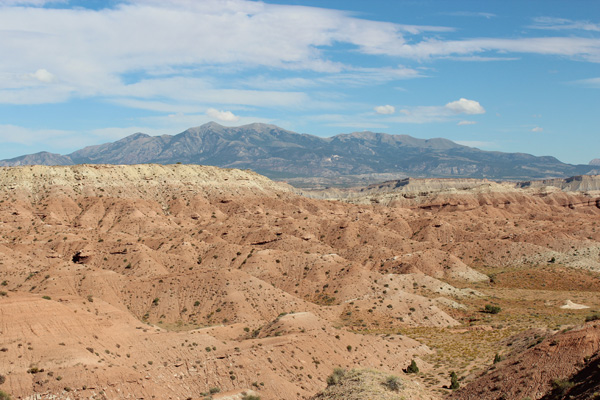
I found the western approach road and began the drive in. The trailhead at Bull Creek Pass lies in the notch on the ridge near the center of the above photo. Mount Ellen, the high point of the Henry Mountains, is the broad summit left of that notch. The pointy peak to the left of Mount Ellen is Mount Ellen Peak. The trailhead lies 24 road miles from the highway. That afternoon I was driving in 19 miles to the McMillan Spring Campground to find a campsite.
I crossed Sandy Creek after a few miles. It was dry and the short, steep crossing was easy in my jeep. Most of the 19 miles of dirt/rock road to McMillan Spring Campground turned out to be in good shape. The last 3 miles of road to the campground were steeper and rockier. But the road was much better than some I have experienced elsewhere.
At the campground I found several other friendly campers and a roomy and quiet campsite amongst the Ponderosa pines. I was surprised to discover I had digital cell service so I called Linda to assure her of my situation. From my campsite I had only 5 more miles to drive to the trailhead the next morning. I enjoyed a quite pleasant evening and night.
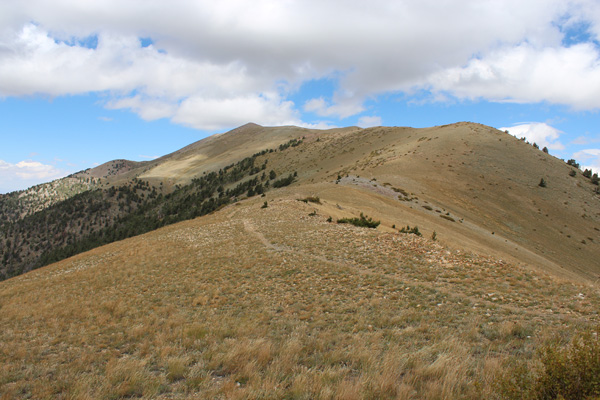
The next morning, September 4, I drove the last 5 miles of dirt/rock road to the Mount Ellen Trailhead. The road gained a lot of elevation to reach Bull Creek Pass (10500 feet). My Jeep made easy work of it with its clearance, 4WD, and knobby 6-ply tires. I met several ATVers on the drive and parked next to an ATV at the trailhead.
The Mount Ellen summit lies about two miles north of the trailhead. I left my Jeep and followed the trail along an open ridge. It was breezy along the ridge but the temperature was ideal for hiking.
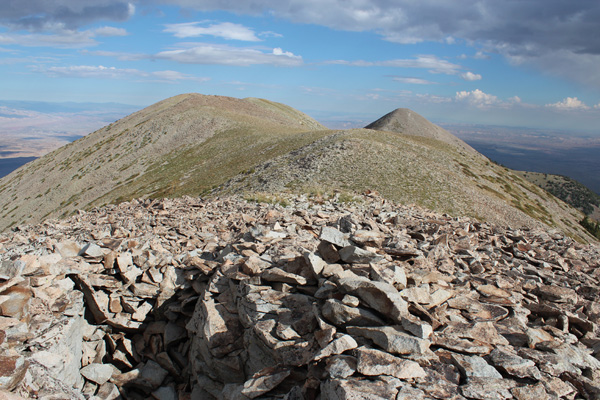
I climbed up to the false summit and saw the true summit for the first time. The summit of Mount Ellen was just a few feet higher to my left. Mount Ellen Peak appeared as a cone in the distance to its right. Close in front of me was a wind shelter made in the talus.
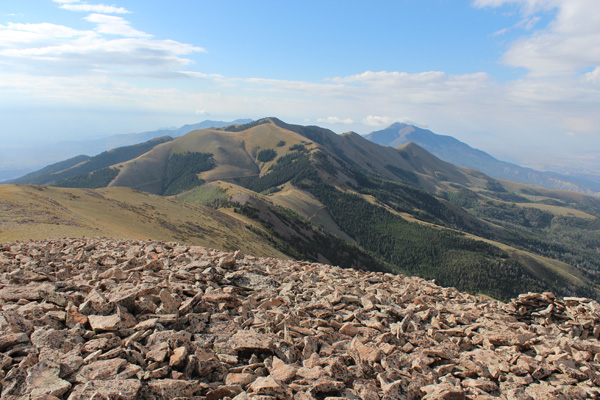
I turned around and enjoyed the view of the Henry Mountains from the false summit to the south. I could just make out my jeep parked at Bull Creek Pass.
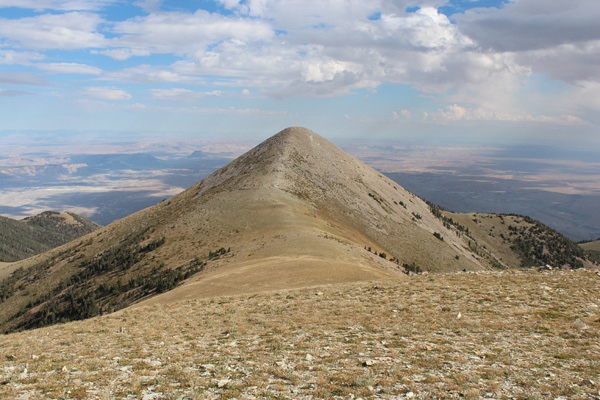
I continued and soon arrived at the summit of Mount Ellen. There I found and signed a scrap of paper in the summit registry. I was impressed with the many visits the peak received each year. Mount Ellen Peak rose impressively to the north and I felt compelled to include it in my hike.
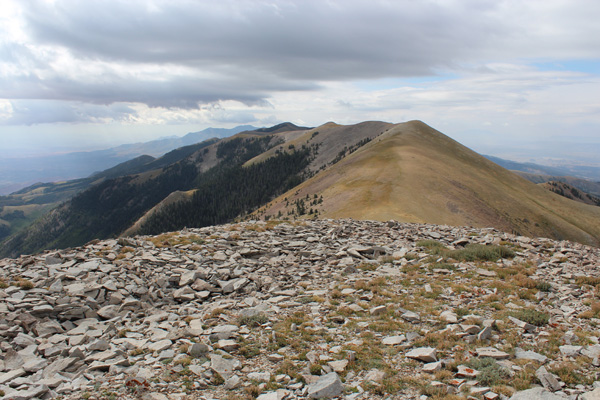
I descended to the saddle between Mount Ellen and Mount Ellen Peak and climbed upwards. Most of the climb up Mount Ellen Peak is on talus fields, but a nice trail helps considerably. Mount Ellen Peak has a summit registry that shows it is frequently visited. The summit of Mount Ellen is near the center of the photo above. The Henry Mountains stretch out to the south.
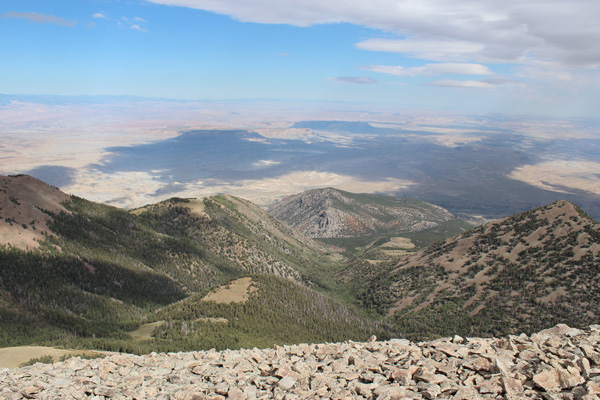
As these photos illustrate, these desert peaks are ecological “sky islands” with habitats much different from the surrounding basins. I was glad to have added the peak to my hike – it only added about two miles and 800 feet of elevation gain to my route.
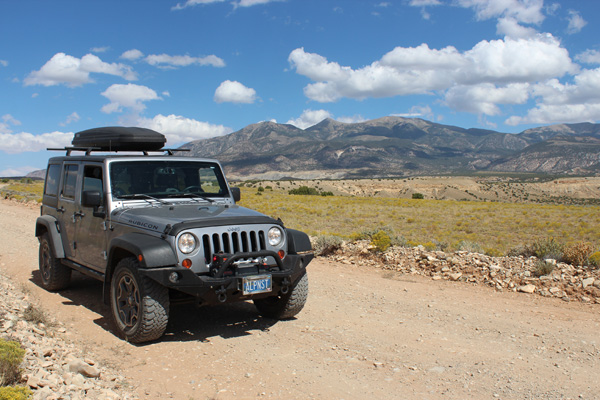
I returned to the trailhead and drove out of the Henry Mountains with great satisfaction. I am quite proud of my Rubicon for how it handled the trip. The Jeep’s high clearance and 4WD was helpful. Its 6-ply knobby tires were quite reassuring for so many miles of rock higher on the road. The experience was scenic and fun. It gave me confidence that my jeep and I were ready to explore other remote areas in the west.

Leave a Reply